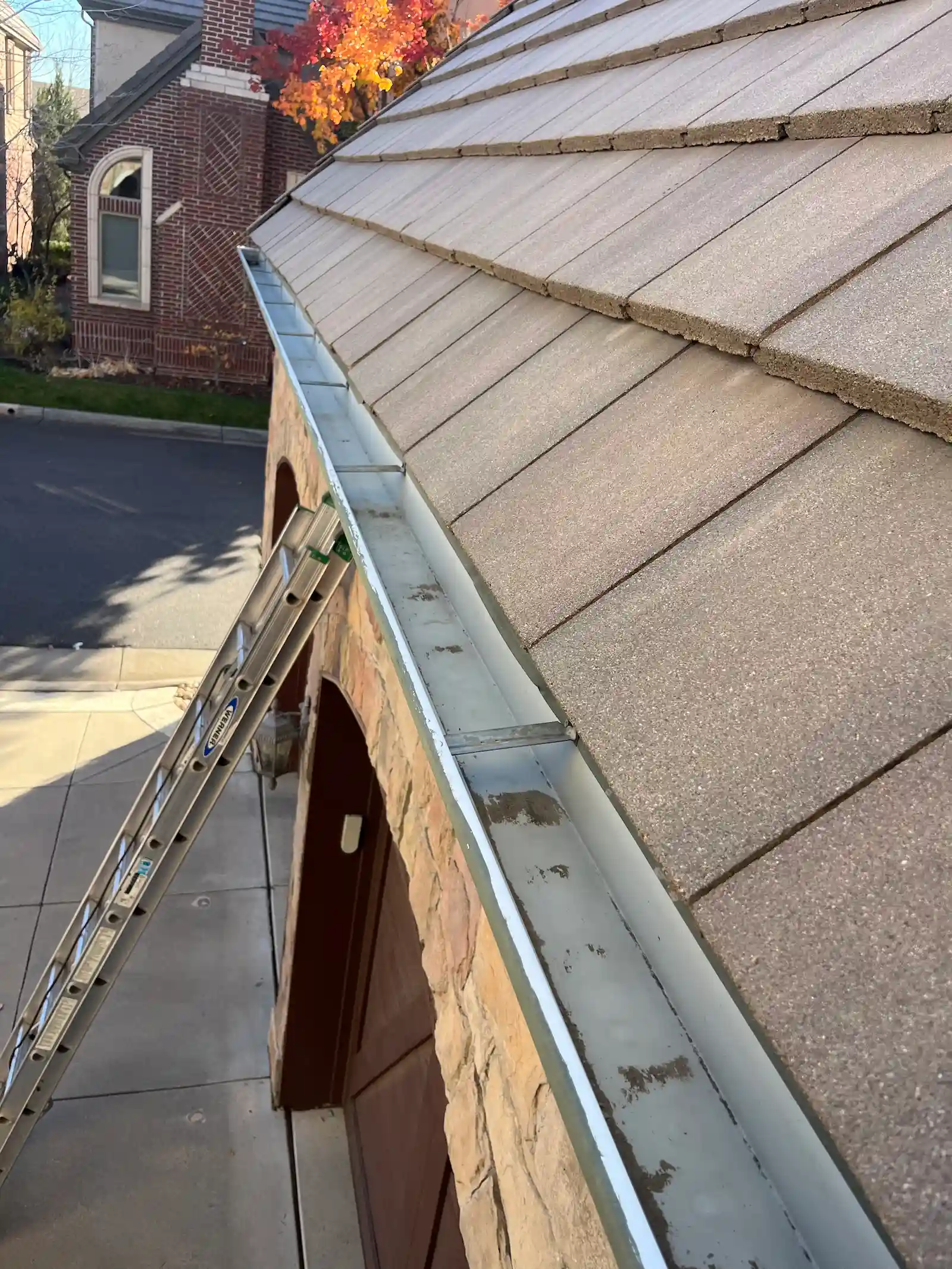
Most Denver homeowners pay $200 to $350 for a professional gutter cleaning. Where you land inside that range comes down to the size and complexity of your home, and a recurring plan brings the per-visit number down from there.
That's the answer. The rest of this guide covers how the pricing actually works, what makes one Denver home cost more than another, the add-on charges that show up on other companies' invoices, and how often gutters here really need to be cleared. It reflects how we price our gutter cleaning service across Denver, Aurora, Lakewood, Littleton, and the surrounding metro.
Denver gutter cleaning prices by home size
Recurring plans lower the per-visit cost. A twice-a-year plan saves 10 percent. Three times a year saves 20 percent.
Why we price by home size instead of by the foot
You'll see companies quote gutter cleaning by the linear foot — usually somewhere between $0.70 and $2 per foot — or by the number of stories. Both approaches have the same problem for you as the homeowner: the final total stays open until someone shows up and measures.
If you don't know your linear footage, and almost nobody does, a per-foot quote isn't a price. It's a range with a multiplier attached. A 200-foot home at $2 per foot is $400. The same home quoted at $0.70 is $140. Both are technically the same quote, and neither one tells you what you're going to pay.
We price by size tier so the number you hear on the phone is the number on the invoice. No measuring on arrival, no revised total, no line items you didn't agree to.
What decides where your home lands
Home size and roofline. Total roofline is what actually matters, and it doesn't track square footage as neatly as people assume. A 2,400 square foot ranch with a simple gable roof has far less gutter than a 2,400 square foot two-story with four rooflines, dormers, and a wraparound porch. Corners, valleys, and transitions each add gutter and each add time. That's why pricing steps up by size and complexity together rather than square footage alone.
Height and pitch. Two-story and three-story sections mean taller ladder setups, more repositioning, and more time spent working safely. Steep pitches and sections where landscaping, decks, or tight side yards block ladder placement all add time to the same footage.
Debris load. This is the variable that swings the most, and Denver has a specific debris profile worth understanding.
The four debris seasons Denver homes actually deal with
Most national gutter advice assumes one leaf drop in the fall. That's not how it works here.
Winter into early spring. Heavy wet snow and freeze-thaw swings wash bark, seed pods, and roof grit down into the gutters. It's the season nobody thinks about, and it leaves a layer of grit at the bottom of the trough that's heavier than it looks.
Cottonwood, in May. This is the one that catches Denver homeowners out. Cottonwood fluff clogs faster than any other debris in Colorado. It's dense, it mats into a felt-like layer when it gets wet, and it's nearly invisible from the ground until the gutter overflows. Homes anywhere near mature cottonwoods should plan a cleaning after the drop, not before.
Pine needles, year-round. Ponderosa and lodgepole pines shed continuously rather than in a single window. Needles are small enough to slip through most basic gutter screens and they weave together into a mat that traps everything else. If you have large pines near the house, twice a year isn't enough.
Leaf drop, October into November. The familiar one, and the most important to clear before the first hard freeze. Gutters that go into winter full are how water ends up behind your fascia.
And then there's hail. Denver sits in one of the most hail-exposed metro areas in the country, and a storm does two things to your gutters at once: it knocks loose debris down off the roof, and it strips granules off your shingles. That grit is heavy, it sinks, and it packs into a sludge at the bottom of the trough that a light rinse won't move. A cleaning after a significant hit is the one Denver homeowners routinely skip and shouldn't.
What a complete cleaning includes
Scooping the channels is the part everyone pictures. It's not the part that matters most.
A complete cleaning covers:
- Hand removal of debris from the gutter trough
- Clearing and flushing the downspouts with water, then confirming flow at the outlet
- Bagging and hauling away everything removed
- A walk of the system checking for loose fasteners, separated seams, sagging runs, and early fascia rot
- Notes and photos of anything found
The downspout step is where most of the difference between quotes hides. A clean gutter that drains into a blocked downspout is not a working gutter — water backs up over the edge exactly as if nothing had been done. Clearing the trough and flushing the downspouts are two separate jobs, and a quote that comes in well under the ranges above has usually dropped the second one.
The inspection matters more than people expect too. A crew on a ladder at every corner of your roof is in the best position anyone will be in all year to catch a failing hanger or a soft spot in the fascia while it's still a cheap fix. Catching a rotting fascia board during a $250 cleaning is a very different conversation than finding it after water has been getting behind the gutter for two seasons. If something has already failed, our gutter repair and soffit and fascia crews can address it before it spreads.
Four upcharges to ask about before you book
These are the line items that turn a quoted price into a larger invoice. A straight operator will answer all four without hedging.
Is downspout flushing included, and does that mean water? Some companies check downspouts by eye or by dropping something down them. That isn't flushing.
Do you haul the debris away? Some crews bag it and take it. Some bag it and leave it at the curb. Some blow it into the landscaping and call it done.
Is there a second-story or difficult-access surcharge? These are legitimate costs, but they belong in the original quote — not added after a crew arrives and looks at the house. If nobody asked how many stories your home has before quoting, expect the number to move.
How do you handle gutter guards? If you have gutter guards installed, most systems have to come off, get cleaned underneath, and go back on correctly. That's real additional work and it should be priced up front, not discovered on the day. If you're weighing whether guards are worth it, here's what gutter guards cost in Denver.
How often Denver gutters need cleaning
Two to three times a year fits most Front Range homes.
Twice a year works for homes with light tree cover: once in late spring after the cottonwood drops, once in fall after the leaves are down. Don't clean at 60 percent leaf drop — you'll be doing it again.
Three times a year is right for homes under heavy pine, spruce, or cottonwood. Continuous shedding means a two-visit schedule leaves the gutter loaded for months at a stretch.
Quarterly makes sense for properties with mature trees on multiple sides, and for foothills homes in the Evergreen, Morrison, and Golden corridor where debris loads run heavier and snow arrives earlier.
Staying ahead of it is also cheaper than catching up. Clearing a season of packed, wet, frozen debris takes longer than clearing a gutter that was cleaned four months ago, and it's harder on the system.
How to tell your gutters need cleaning without a ladder
You don't need to climb anything to know. Watch for:
- Water sheeting over the edge during rain instead of running to the downspouts
- Plants, weeds, or seedlings growing in the trough
- Sagging sections, or gutter pulling away from the fascia
- Birds or pests nesting along the roofline
- Streaks, staining, or mildew on the siding below the gutter line
- Water pooling near the foundation after a storm
Cottonwood and pine buildup usually shows up as slow drainage well before anything looks bad from the ground. If water takes noticeably longer to clear after a rain than it used to, the gutter is already partly blocked.
Should you clean them yourself?
If you have a single-story home, solid ladder footing, and you're steady at height, cleaning your own gutters is a reasonable Saturday. Budget two to four hours and expect to get filthy.
Two things make the DIY math worse than it looks.
The first is fall risk. Gutter work specifically involves reaching sideways from a ladder, which is the exact motion that causes ladders to slide out. On a two-story home or a steep pitch, the safety math stops favoring DIY pretty quickly.
The second is what an untrained pass misses. Loose hangers, a failing seam, early fascia rot, a downspout that's clear at the top and blocked at the elbow — these are cheap to fix when caught and expensive when they're not. The gap between a DIY clean and a professional one usually isn't how clean the gutter is. It's what got noticed while someone was up there.
Get Your Price in Minutes, No Visit Required
Answer a few quick questions about your home and get an instant price. No in-person visit needed.
What clogged gutters actually cost you
The reason any of this matters: water that overflows a blocked gutter goes somewhere, and the somewhere is almost always your foundation.
Denver sits on expansive clay soils that swell when they take on water and shrink when they dry. Repeated saturation right at the base of the house is one of the more effective ways to move a foundation over time, and foundation work in this market runs into the thousands.
Closer to the roofline, chronic overflow soaks the fascia board the gutter is mounted to. Once that wood goes soft, the gutter loses its anchor and the whole system starts pulling away — which means you're paying for fascia replacement and a gutter rehang at the same time. At that point replacing the system is often the more sensible dollar.
A cleaning is inexpensive next to either one.